Hairline Fracture
Four memory blocks were admitted under one export seal. Test the manifest's claim against every block you actually received and identify any break in integrity.
Objective
By completing this module, you will be able to:
- calculate and compare SHA-256 digests without modifying evidence; and
- explain precisely what a digest mismatch establishes about an artifact.
Before you begin
Download the manifest and all four memory blocks into one local folder. Review SHA-256 and keep filenames paired with their manifest identifiers.
Concepts
A cryptographic digest is a fixed-length fingerprint of exact bytes. Matching a retrieved file to a trusted manifest supports the conclusion that those bytes are the bytes described by the manifest. A mismatch establishes that the two byte sequences differ; it does not, by itself, identify who changed them or which version is truthful. The manifest must also have a trusted origin.
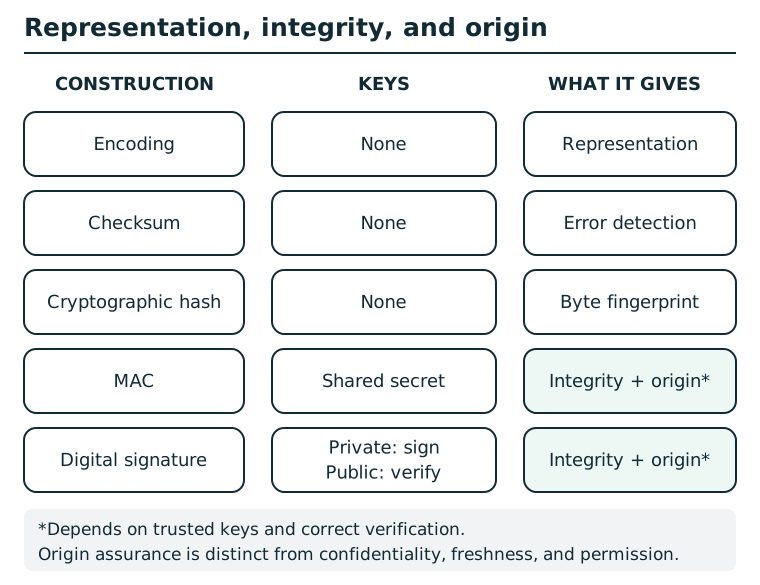
Encoding is reversible. Checksums detect accidental errors. Hashes fingerprint bytes but do not authenticate a source. A MAC provides integrity and origin within a group that shares a secret; any member can create tags. A signature binds bytes to a private-key holder when verification and public-key trust are correct. None of these alone encrypts, proves freshness, or grants authorization.
Suggested tools
- Hashing utility:
sha256sum,shasum -a 256, or a trusted graphical checksum tool can calculate a digest locally. - Evidence table: Record filename, manifest digest, calculated digest, and match status before interpreting content.
Tool practice
Rehearse the worked tool exercise before using challenge data.
Run the two-file hash exercise before hashing the evidence downloads. Hash each file body as bytes, keep the original filename, and make an expected/calculated/match table. Copy the calculated digest from your tool, not the manifest.
Investigation
Observe
Confirm the algorithm declared by the manifest and map each identifier to one downloaded file. Calculate a digest for every file, including those that look ordinary, and preserve the complete hexadecimal results.
Form a hypothesis
Does one retrieved block differ from the version bound into the manifest? What can you conclude from that difference without assuming that either version's narrative is true?
Test carefully
Compare digest strings exactly. Submit the mismatching memory identifier to the challenge form, then record both the identifier and the digest of the file you actually received in the case ledger. Do not submit the digest printed in the manifest as though you calculated it from the download.
Progressive hints
This pane has no in-app nudge. The workbook offers the following additional guidance when needed.
Hint 1
Build a four-row table and compare each calculated hexadecimal digest with the digest beside the same memory ID.
Hint 2
Exactly one row should differ. The ledger asks for that row's ID and the digest you calculated from the downloaded file.
Troubleshooting and reset
If all rows appear to fail, confirm that you hashed the files themselves rather than copied text, and check that your tool did not rewrite line endings. If all rows appear to match, verify that each filename is paired with the corresponding manifest ID. Re-download only from the pane if local files were edited.
Witness seal filing and recovery
Record this pane's critical finding in the active session before filing its witness seal. Supporting findings are optional. An unearned seal is rejected without consuming a failed-flag attempt. To recover an earned seal, revisit this pane or repeat the accepted finding in the same session; neither adds progress twice. All six critical findings and their six filed seals unlock release, seal, and return. Supporting findings strengthen the ending and remain available after it.